
Checklist in Smart locks and access
Are smart locks easy to install? Checking your Vancouver, BC door first
Smart locks are easy to install in Vancouver, BC when your door already has the right holes. Schlage says its smart deadbolts are battery-powered, need no hardwiring and install with a screwdriver, so the work is in the fit. Schlage gives a 2-3/8 to 2-3/4 inch standard backset, and Kwikset's instructions call for a 2-1/8 inch face bore.
By the Saturn Home Automation team Updated
Why the door check matters
The lock is rarely the problem. The door is. A smart deadbolt needs holes of the right size in the right places, a door of the right thickness and, for some doors, extra preparation.
Schlage says its smart deadbolts are battery-powered, need no hardwiring and install with a screwdriver. That removes the electrical work, and it leaves the measurements. For the choice of lock itself, see types of smart locks.
Checking whether a smart lock fits your door?
Door checks before you buy a smart lock
- Measure the backset The backset runs from the centre of the cross bore to the edge of the door. Schlage gives 2-3/8 to 2-3/4 inches as the standard backset for its residential locks, so measure before you choose.
- Check the bore sizes Kwikset's drilling instructions call for a 2-1/8 inch (54 mm) face hole and a 1 inch (25 mm) edge hole, with the deadbolt centre about 5-1/2 inches (140 mm) above the knob or lever centreline.
- Look for a 1-1/2 inch hole A door already drilled with a 1-1/2 inch (38 mm) hole follows separate steps in Kwikset's instructions, so the lock may need extra preparation.
- Measure the door thickness Two maker examples: Kwikset lists its Halo Touch fingerprint lock for doors 1-3/4 to 2 inches thick. Schlage's F60 and F58 handlesets on doors 1.75 to 2.25 inches thick need a separately sold thick-door kit, and thicker doors are not supported.
- Count the bores Double bore doors use a deadbolt plus a handle, knob or lever and are typically exterior doors. Single bore doors use a knob or lever only.
- Plan for batteries, not wiring Schlage says its smart deadbolts are battery-powered, need no hardwiring and install with a screwdriver.
- Get permission first A tenant needs the landlord's written agreement or a director's order. Under BC's standard strata bylaw 5, a strata owner needs written approval to alter a door on the exterior or fronting common property.
The door checklist
Seven checks, each with its why. The list above gives the short form, and here is the reasoning.
Backset. It is the distance from the centre of the cross bore to the edge of the door. Schlage gives 2-3/8 to 2-3/4 inches as the standard for its residential locks. A lock built for another backset will not reach the door’s edge.
Bore sizes. Kwikset’s drilling instructions call for a 2-1/8 inch (54 mm) face hole and a 1 inch (25 mm) edge hole. The deadbolt centre sits about 5-1/2 inches (140 mm) above the knob or lever centreline.
An existing 1-1/2 inch hole. Kwikset says doors already drilled with a 1-1/2 inch (38 mm) hole follow separate steps.
Thickness. For example, Kwikset lists its Halo Touch fingerprint model for doors 1-3/4 to 2 inches thick, with a 2-1/8 inch cross bore and an adjustable latch backset. Schlage says F60 and F58 handlesets on doors 1.75 to 2.25 inches thick need a separately sold thick-door kit, and doors thicker than 2.25 inches are not supported.
Single or double bore. Schlage says double bore doors use a deadbolt plus a handle, knob or lever and are typically exterior doors, while single bore doors use a knob or lever only.
Power. Plan for batteries. Schlage’s smart deadbolts run on them, with no hardwiring.
Permission. In a BC rental, a tenant changes a lock only with the landlord’s written agreement or the director’s order. Under BC’s standard strata bylaw 5, a strata owner needs written approval before altering doors on the exterior or fronting common property. See changing locks in a BC rental and strata smart lock rules.
Common mistakes
- Measuring from the door face instead of the cross bore centre.
- Buying a lock before reading its door thickness range.
- Assuming a handle can go where only a knob bore exists.
- Starting before the landlord or strata has agreed in writing.
For a metal, glass or fire-rated door, check the maker’s door-type list before you buy.
What you handle and what we handle
You handle the measurements and the permission. Measure the door, read the lock’s spec page, and get written agreement from the landlord or the strata.
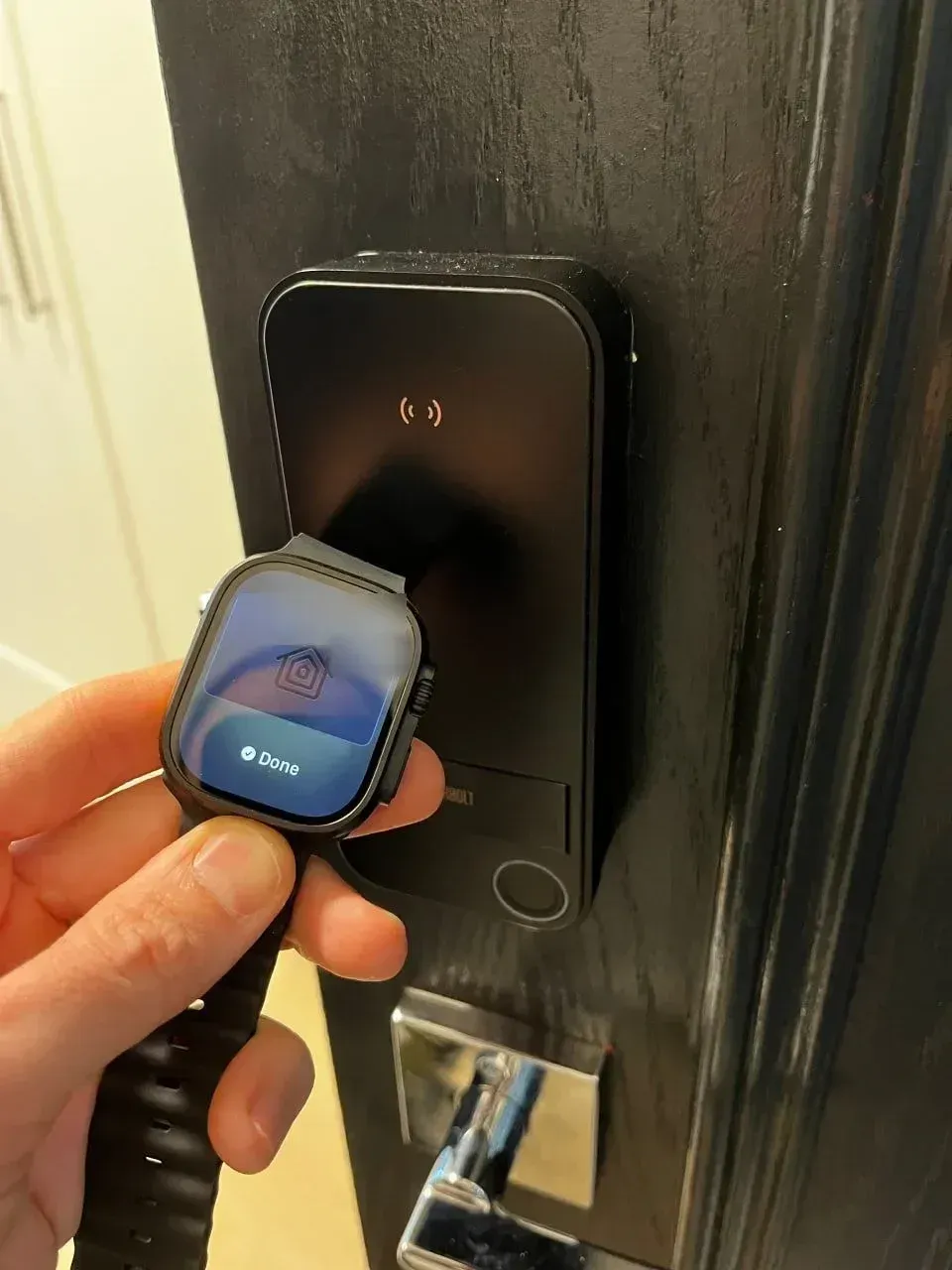
We handle the install and the setup, including locks that open with a tap or an Apple Watch. To have a lock fitted in Vancouver, see our smart locks service. Whether the lock is worth having at all is in are smart locks worth it.
The service behind this guide
Questions people ask
Are smart locks easy to install?
On a standard door, Schlage says its smart deadbolts are battery-powered, need no hardwiring and install with a screwdriver. The hard part is fit, not wiring. Measure backset, bore sizes and thickness against the lock's spec page before you buy, and get any landlord or strata approval first.
Will a smart lock fit my door?
It fits when your door's measurements sit inside the lock's listed range. Check the backset, the bore sizes and the door thickness on the maker's spec page. Kwikset's instructions, for example, use a 2-1/8 inch face bore and a 1 inch edge bore. For a metal, glass or fire-rated door, check the maker's door-type list.
What is a door backset?
The backset is the distance from the centre of the cross bore to the edge of the door. Schlage gives 2-3/8 to 2-3/4 inches as the standard backset for its residential locks. Measure from the edge of the door to the centre of the large face hole.