
Cost guide in Heating and smart thermostats
BC Hydro time-of-day pricing: what it does to a baseboard bill in Vancouver, BC
BC Hydro time-of-day pricing adds 5 cents per kWh from 4 to 9 p.m. and takes 5 cents off from 11 p.m. to 7 a.m., as read November 2026, for Vancouver, BC homes that opt in. In our example, the same 4.5 kWh of baseboard heat a day costs $13.95 less over 31 days in the overnight window than in the evening one.
By the Saturn Home Automation team Updated
The hours and adjustments, as read November 2026
BC Hydro’s time-of-day pricing adds 5 cents per kWh to electricity used from 4 to 9 p.m. and takes 5 cents per kWh off electricity used from 11 p.m. to 7 a.m. The hours from 7 a.m. to 4 p.m. and from 9 to 11 p.m. carry no surcharge or discount. BC Hydro describes the result as electricity that is most expensive in the evening and cheapest overnight.
| Hours | Adjustment per kWh, as read November 2026 |
|---|---|
| 4 p.m. to 9 p.m. | add 5 cents |
| 11 p.m. to 7 a.m. | take off 5 cents |
| 7 a.m. to 4 p.m., and 9 p.m. to 11 p.m. | none |
The plan can change, so read BC Hydro’s page on the day you decide.
Thinking about time-of-day pricing with smart heat?
Worked example
Example: 4.5 kWh a day of baseboard heat, evening against overnight
An example, not a measurement. One 1,500 W baseboard on for an assumed 3 hours a day, with those hours either inside the 4 to 9 p.m. window or inside the 11 p.m. to 7 a.m. window, over 31 days. The base is BC Hydro's Tier 1 rate as read November 2026, and the rest of the home is assumed to stay in Tier 1.
- Heater load 1,500 W, Sinopé's sizing example: a 6 ft baseboard at 250 W per foot on 240 V 1.5 kW
- Hours on per day (assumption) Chosen for the example 3 hours
- Energy per day 1.5 kW x 3 h 4.5 kWh
- Evening surcharge over 31 days 4.5 kWh x 5 cents = 22.5 cents a day; 139.5 kWh over 31 days x $0.05 $6.98
- Overnight discount over 31 days, same energy 4.5 kWh x 5 cents = 22.5 cents a day; 139.5 kWh over 31 days x $0.05 $6.98
- Base cost at Tier 1, no adjustment 139.5 kWh x $0.1187 per kWh $16.56
- Evening window, 16.87 cents per kWh 139.5 kWh x 16.87 cents $23.53
- Overnight window, 6.87 cents per kWh 139.5 kWh x 6.87 cents $9.58
- Gap between evening and overnight $23.53 less $9.58 $13.95
Result. The same 139.5 kWh costs $23.53 in the evening window and $9.58 overnight, a gap of $13.95 over 31 days. The example ignores comfort, assumes the heater's use is the same in both windows, and does not say your home can shift its heat.
How it sits on top of the tiered rate
Time-of-day pricing is a layer on a base rate, not a replacement for it. It is optional and can be combined with either the tiered rate or the flat rate plan. The base in our example is the tiered rate: 11.87 cents per kWh in Tier 1 and 14.08 cents in Tier 2. Our guide to the cost to run baseboard heaters prices the base on its own.
So an evening kilowatt-hour in Tier 1 is 16.87 cents, and an overnight one is 6.87 cents. Those are our sums from the two published figures, and they apply only to the heater’s energy while the rest of the home stays in Tier 1.
A worked example with one 1,500 W baseboard
Take one 1,500 W baseboard, which is Sinopé’s own sizing example: 6 ft at 250 W per foot on a 240 V circuit. Assume it runs for 3 hours a day. That is 4.5 kWh a day, or 139.5 kWh over 31 days.
In the evening window the surcharge is 22.5 cents a day, $6.98 over 31 days. Moved into the overnight window, the same energy earns a discount of 22.5 cents a day, also $6.98 over 31 days. At Tier 1 the heater’s energy costs $16.56 without adjustments, $23.53 in the evening and $9.58 overnight, a $13.95 gap.
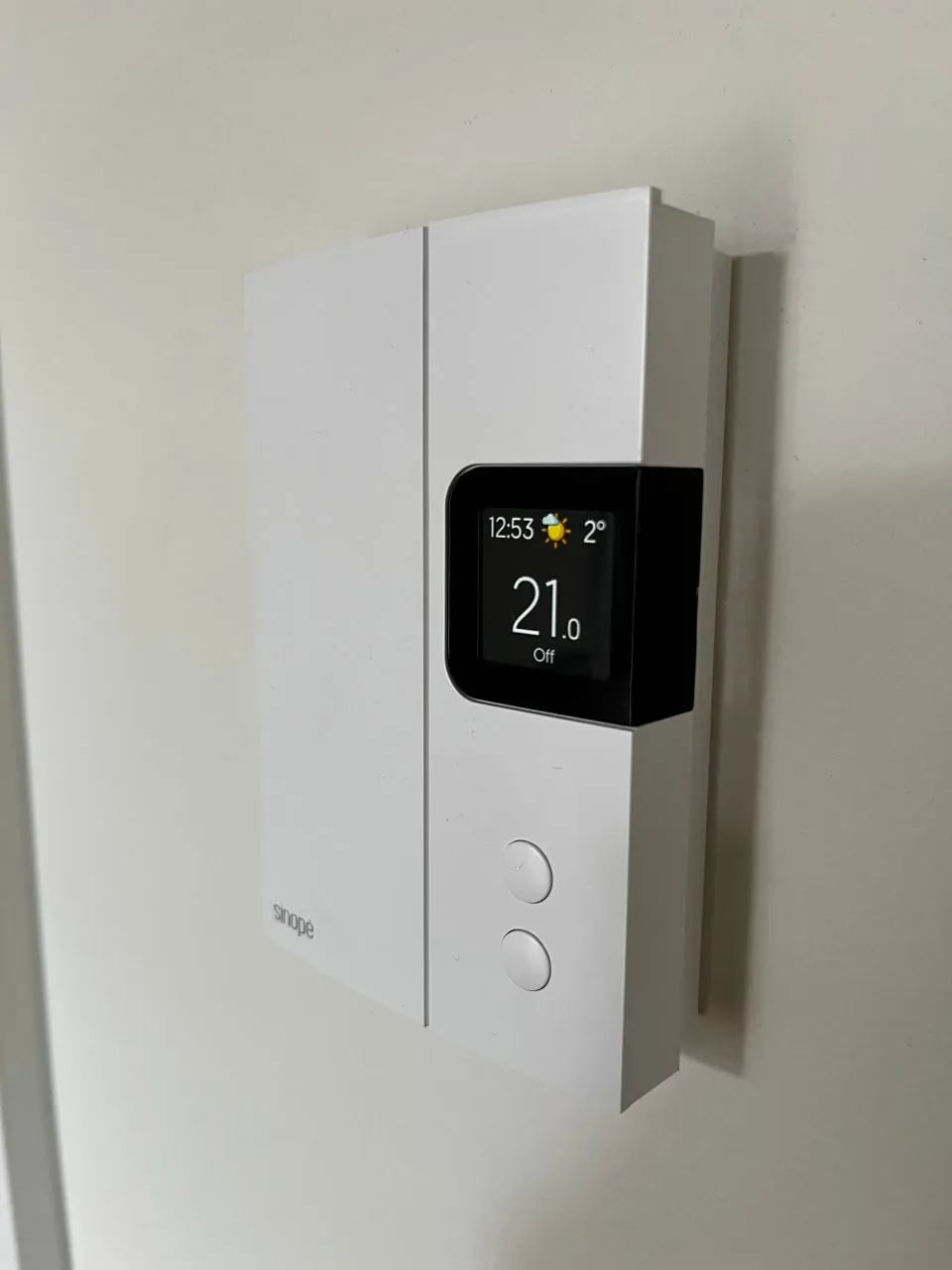
The 3 hours is our assumption, so run the same sum with your own heater’s hours. A programmable thermostat is what moves the hours. Saturn Home Automation offers smart thermostats for electric baseboards with schedules, remote control and away modes, and our climate control page covers what we set up.
Who time-of-day pricing fits
BC Hydro’s own terms narrow who it fits. Check each line before you opt in.
- It is optional, and works with the tiered or flat plan.
- It needs a connected smart meter.
- Common areas of multi-residential buildings are not eligible.
- BC Hydro generally does not recommend it for apartment or condo customers unless their use includes EV charging. It says the chance to save is limited in smaller homes and buildings may restrict late-evening noise.
If you live in a condo, BC Hydro’s advice is the one to weigh against the example above.
What isn’t included
The example leaves out the basic charge, taxes, any other line on your bill and every Tier 2 effect. It also leaves out Peak Saver events, which are a separate programme from pricing. Our guide to BC Hydro’s free smart thermostats covers those events. How heating demand changes month by month is in our Vancouver climate by month data page.
How to check your own numbers
Use your own watts and hours. Read the watts from each heater’s label, or estimate 250 W per foot at 240 V. Multiply kilowatts by the hours in each window, then by the days in your billing period, and apply the 5-cent adjustment to each window’s kilowatt-hours.
For a full bill, add the basic charge, taxes and the rest of your home’s use from your own bill. Check the plan page before you switch.
The service behind this guide
Questions people ask
What time of day is BC Hydro electricity cheaper?
On time-of-day pricing, as read November 2026, it is 11 p.m. to 7 a.m., when BC Hydro takes 5 cents per kWh off. The evening, 4 to 9 p.m., adds 5 cents. Hours from 7 a.m. to 4 p.m. and from 9 to 11 p.m. carry no adjustment. The plan is optional.
Is time-of-day pricing worth it in a condo?
BC Hydro says it generally does not recommend time-of-day pricing for apartment or condo customers unless their use includes EV charging. It says the chance to save is limited in smaller homes and buildings may restrict late-evening noise. That is BC Hydro's advice, as read November 2026.
Can I use time-of-day pricing on the tiered rate?
Yes. BC Hydro says time-of-day pricing is optional and can be combined with either the tiered rate or the flat rate plan. It needs a connected smart meter, and common areas of multi-residential buildings are not eligible. Check the plan page on the day you switch, because terms change.